

Do I Need A Termite Service Uga
Termite Prevention and Command
Zoom in 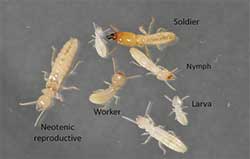
Figure 1: Termite castes/developmental stages in a subterranean termite colony. The king and queen are not shown.
Zoom in 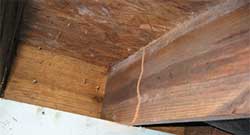
Figure 2: A termite mud tube on a beam.
Zoom in 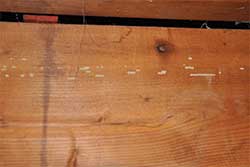
Figure 3: Termite mud tubes in woods.
Termites are the most destructive insects to homes. In the U.S., termite control costs solitary exceeds $i.5 billion each year. About people are not aware of termites until significant damage to the structure has occurred. It is therefore very important to sympathise the basic biology, prevention, and control of termites.
Termite Species
All naturally occurring termites in the northeastern U.S. belong to a group chosen subterranean termites (genus Reticulitermes) (Figure 1). The common name comes from their addiction of nesting in the soil. Their nests are rarely found above ground. Subterranean termites build mud tubes and bring soil to the woods where they feed (Figure 2 and iii). In the southern U.Southward. and western U.S., drywood and dampwood termite species are also found. They nest in wood to a higher place ground. Occasionally, drywood termites may be transported along with infested furniture or timber to other parts of the country. Drywood termites exercise not bring soil to the wood, and they produce pellets equally they feed. These termites usually exercise not cause damage to structures exterior their natural distribution areas.
Termites are social insects with various castes. Most of the members are white in color. Only the king, the queen, and swarmers (as well chosen alates) are darkly pigmented. Soldiers' heads are red. Most people encounter termites during spring when termite swarmers (Effigy 2) leave their natal nests. Termite swarmers may be confused with emmet swarmers merely can exist distinguished by the following:
| Points of Difference | Termite Swarmers | Ant Swarmers |
|---|---|---|
| Size of wings | Hind wings are approximately the same size equally the forewings. | Hind wings are much smaller than the forewings. |
| Colour of wings | Dusky | Clear |
| Veins of wings | Weak | Very singled-out |
| Shape of body | The abdomen is joined snugly to the thorax, without a node or waist. | The belly is distinctly separated from the thorax by a very small node or sparse waist. |
| Antennae | Beadlike | Elbow-shaped |
Termite Biological science
Each subterranean termite colony contains reproductives (a male monarch, a queen, and some neotenic reproductives), larvae, nymphs, workers, and soldiers (Figure 1). The neotenic reproductives are non-alates, and they produce fewer eggs than the queen. The majority of colony members are workers. They look for food, feed the other members of the colony, and maintain the nest and foraging tunnels. Soldiers have rectangular brownish heads and long mandibles. They typically account for 1–ii% of the members. Nymphs develop into alates or neotenic reproductives. A colony may have hundreds or thousands of neotenic reproductives. The neotenic reproductives play an important role in the growth and expansion of colonies. Thus, killing the queen will not crusade the colony to die. A mature colony has 60,000 to 1 million individuals.
Subterranean termites naturally occur in forests and urban environments where cellulose materials (such as stumps, mulch, and dead copse) be. Most of the houses in the U.S. incorporate woods materials. When the forest materials become moist or contact the soil, termites volition find their way into the wood. Workers constantly forage for food. Their only food is cellulose material such as wood and newspaper. Nether ideal conditions, a termite colony of 60,000 would swallow about 5 grams, or i/5 ounce of wood each day. A subterranean termite colony may cover 260 ft linear altitude.
A new subterranean termite colony can exist formed in 2 means:
- a pair of swarmers (a male person and a female alate) mate, drib wings, and build a nest;
- budding from an existing colony.
The swarming adults just appear once or twice from mature colonies every year. Hundreds or thousands of swarmers go out the nest during warm sunny days between April–June. This is when most homeowners first observe termites in their homes. After a brief flight, the swarmers soon drop their wings and form pairs. They then wait for a moist, sheltered place to build a nest. It takes several years for the colony to mature and produce swarmers. As the colony grows, part of it may split from the main colony and form a new colony. Neotenic reproductives head such budded colonies.
How to Conduct a Proper Termite Inspection?
It is not difficult for a layperson to inspect a home for termites when obvious signs are present (Figure 3 and four). Unfortunately, mud tubes are often absent-minded, making it very difficult to determine whether termites are present. It is even more difficult for a layperson to distinguish between one-time termite damage and new termite damage. For these reasons, homeowners are encouraged to consult with experienced professionals for a quality inspection. The following are the general procedures for conducting a termite inspection. Beginning, obtain inspection tools. A flashlight and a probing tool (garden trowel, screw driver, or ice choice) are a must. Knee joint pads, a difficult chapeau, a mirror, collection bottles for specimens, and a moisture meter volition assist with an inspection. An inspection should focus in areas where at that place is high wet and wood or other cellulose materials: window sills, the bottom of door frames, the clamber space, the basement, and foundations immediately in a higher place ground, etc. Wait for mud tubes and damaged forest. Tap the exposed wood with a probing tool. A hollow sound may reveal damage beneath the woods surface. Old houses may have mud tubes from previous infestations. Gently suspension a pocket-sized department of the mud tubes to determine whether they are moist and whether termites are currently present. Active mud tubes can be distinguished from quondam mud tubes by a darker color, moist soil, and presence of live termites. Employ a garden trowel to examine the mulch near the foundation. If termites are found in the mulch, the construction should exist very thoroughly inspected, since termites can occur in the immediate vicinity. It is a good idea to inspect the house at least in one case a yr in the summer to detect termite activity.
Prevention
It is usually much easier and cheaper to carry preventive work than to treat an infestation. Thus, property owners should follow mutual sense rules to avoid expensive treatment and repair subsequently.
First, avoid wood-to-soil contact or use treated forest if woods has to be used in a moist area. Ideally, any forest in a structure should exist at least half dozen inches above the soil. Repaint whatsoever wood that is close to the ground every few years to forbid moisture intrusion. Do not bury any wood materials (stumps, branches, wood droppings) when building a domicile. Do not place cellulose materials (such as firewood, mulch) immediately next to a house. Using rocks or safe mulch near the house will reduce the probability of termites remaining well-nigh the firm. Cut down shrubs or large copse and remove stumps near the foundation to reduce the presence of roots and plant debris.
Second, reduce moisture and promptly repair leaks. The gutters and down spouts should be properly installed and maintained. Seal cracks and holes on exterior walls to prevent moisture getting within the walls. Clamber spaces should be properly ventilated.
Tertiary, apply treated wood or steel in porches and other areas that are susceptible to termite set on.
Fourth, install stainless steel mesh or pesticide-impregnated sheeting for new construction. These technologies are currently non widely used in the U.S.
Zoom in 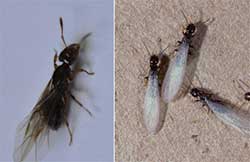
Effigy iv: Comparison of an emmet swarmer and termite swarmers.
Zoom in 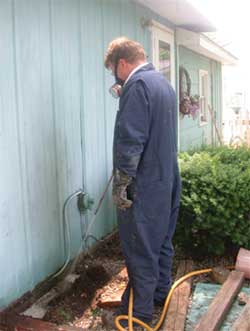
Figure v: Applying liquid insecticide to a trench.
Zoom in 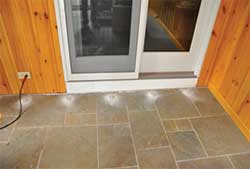
Figure 6: Holes in a slab for injecting insecticide. These will afterwards be filled with mortar.
Zoom in 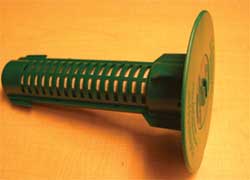
Figure 7: In-ground termite allurement station.
Zoom in 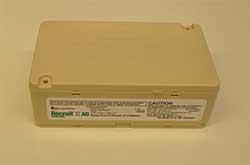
Effigy 8: Aboveground termite allurement station.
Command
Once termites are found in a dwelling house, handling is necessary to kill them. There are two types of treatments usually used: soil treatment and baiting. Proper treatment requires special training, equipment, and materials. Homeowners should expect for licensed professionals to properly eliminate termite infestations.
A soil treatment requires digging a trench effectually the exterior perimeter of the house. A liquid insecticide is then applied to the trench to form a continuous barrier between the house and the soil exterior of the house (Figure 5). In conjunction with the exterior treatment, the insecticide may be applied also locally inside homes in areas where termite activities are found. In areas covered by concrete or forest, small holes are drilled every 12 inches or as the label directs (Figure 6). Insecticides are then injected with a rod, and the holes are plugged or otherwise filled. Because termites nest in the soil and constantly travel back and forth between the soil and the wood, they come in contact with the treated soil. When properly treated, a colony may be eliminated within one or two months. The soil handling can be effective for more v years.
Commonly used liquid termiticides can be grouped into non-repellent and repellent termiticides. Non-repellent termiticides include fipronil, imidacloprid, and chlorfenapyr. These active ingredients are relatively slow-acting. Termites freely re-enter treated soil. They option up enough dose of the material as they pass through the treated areas and transfer the chemical to their nestmates, causing the death of the whole colony. Usually used repellent termiticides include permethrin, cypermethrin, fenvalerate, and bifenthrin. They belong to a chemic grouping called pyrethroids. Pyrethroids are highly repellent to termites and provide a barrier effectually the structure. However, pyrethroid treatments practise non diminish termite populations in soil. Termites in the vicinity of the treatment would continue to forage freely. Thus, non-repellent termiticides are preferred materials used by professionals for treating structures that are already infested.
Baiting is another usually used termite treatment method. In this method, plastic tubes are installed hush-hush at approximately x ft. intervals encircling the house (Effigy 7). Each tube contains wood and/or toxic allurement. The allurement tubes are examined regularly, from monthly to annually, depending on the type of bait tubes being used. Termites foraging around the house will eventually find the wood or bait. The allurement is more than palatable than the wood and contains a dull-acting textile. Termite workers eat the allurement and bring the fabric to the remainder of the members of the colony. A colony volition be killed over a few months in one case termites detect the allurement. Aboveground termite bait stations tin can be placed inside houses where termite activity is found (Figure 8). Each termite allurement needs to be inspected periodically (quarterly to annually) to ensure plenty allurement remains, and that termites are eliminated. Commonly used agile ingredients in baits are noviflumuron, hexaflumuron, and diflubenzuron.
In general, liquid handling is often cheaper than bait treatment, depending upon the size of the structure to be treated. Liquid treatment provides immediate protection to the structure. Disadvantages are:
- The procedures are somewhat destructive (such as drilling holes into concrete surfaces, digging a trench).
- A large volume of insecticides is applied to the environment.
- Structures with a well, spring, or cistern nearby cannot be treated with liquid insecticides due to possible water contagion bug.
Bait treatment has lilliputian environmental bear on because the bait is contained inside capped plastic tubes. Afterwards termites are eliminated, the bait can be removed and no pesticides remain on the belongings. The equipment needed for bait treatment is simple. The handling causes trivial destruction to the property. Disadvantages of this method include:
- Information technology may take several months or more for termites to find the stations.
- The lag fourth dimension between monitoring and baiting extends the period to attain termite control.
- The baits demand to be inspected periodically and maintained.
- Homeowners, their children, or pets may dislodge the bait stations through gardening, playing, or mowing activities.
Do I Need Annual Termite Inspection Service?
Pest command companies oft recommend annual inspection services after termite treatment to observe future termite activeness. This is helpful to detect termite infestation early. Homes surrounded by large trees, old stumps, or beds of deep mulch are more than likely to take new infestations over time. Alternatively, homeowners may use over-the-counter monitoring stations for monitoring termite action. Strategically place the monitors in areas that favor termite survival such as in the mulch, too a stump or wooden deck. Inspect the monitors a few times a twelvemonth between April–Nov. Termite infestations in the northeastern U.S. well-nigh e'er start from outside. Installing monitoring stations around homes is a good proactive method for detecting new termite activeness.
Reference
Mention or display of a trademark, proprietary production, or house in text or figures does not constitute an endorsement past Rutgers Cooperative Extension and does non imply blessing to the exclusion of other suitable products or firms.
Photo credits: Academy of Georgia (Figure iv right); Changlu Wang (Figures 1–3, 4 left, v–eight).
March 2019
Copyright © 2022 Rutgers, The State Academy of New Jersey. All rights reserved.
For more than data: njaes.rutgers.edu.
Cooperating Agencies: Rutgers, The State University of New Jersey, U.South. Department of Agriculture, and Boards of County Commissioners. Rutgers Cooperative Extension, a unit of the Rutgers New Jersey Agronomical Experiment Station, is an equal opportunity program provider and employer.

Do I Need A Termite Service Uga,
Source: https://njaes.rutgers.edu/fs338/
Posted by: bowlingbutersest1984.blogspot.com
0 Response to "Do I Need A Termite Service Uga"
Post a Comment